By philcheetham on
7/29/2010 10:36 AM
Here is an article written by Gord Workum; a Titleist Performance Institute Instructor on why 3D Motion Capture (and Analysis) is better than simple 2D video analysis with regard to the golf swing. I like it and I will follow up with another article adding my point of view.
The only way to measure the efficiency of a golf swing is with 3D Motion Capture; with 2D one can just judge the style of the golfer’s swing. Yes, you can detect the big 12 swing characteristics with 2D, but with 2D you can not quantify any of the big 12 without being subjective. With 3D Motion Capture, you can also detect any of the big 12 swing characteristics, but you can quantify each one of them, objectively, and see if your client is improving their swing efficiency by improving or eliminating the swing characteristic that is causing them to have an inefficient movement. If you are only using 2D video with your clients then you have no way of objectively showing them that they are improving, all your conclusions will...
Read More »
|
By philcheetham on
7/3/2010 12:03 PM
In December of last year my daughter Jennifer asked me to get her into tumbling. She cartwheels everywhere in the house and is more times upside-down than on her feet. So I finally enrolled her in a tumbling class. After two beginner sessions she was hooked and the coach immediately asked her to be in the “pre-team” class. At that point she told the coach “my Dad is an Olympian”. This of course brought the coach out to meet me. His first question was “Can you help us coach?”. I said no for about a month, but then caved-in. Jennifer now enjoys her Dad helping coach and I enjoy occasionally bouncing on the trampoline and unfortunately sometimes going home sore. The team she now competes for is Xtreme T&T, Scottsdale AZ. At the recent State Championships in her age group and level, she took first place on Double Mini-Tramp and second on trampoline! I guess this is her sport.
So what is T&T anyway?
T&T stands for Trampoline and Tumbling. It is a separate division of gymnastics under USA Gymnastics...
Read More »
|
By philcheetham on
6/28/2010 1:12 PM
Three methods of beginning the downswing kinematic sequence are explained; they are:
Stretching: Proximal segment precedes the distal segment, stretching the muscles, putting them in eccentric contraction hence providing more force for later in the downswing. Riding: Proximal and distal segment turn at the same speed in the downswing, the muscles are in isometric contraction to stabilize the distal segment. Large force is built up between the segments also providing large initial force for later in the downswing. Fanning: Distal...
Read More »
|
By philcheetham on
6/23/2010 10:36 PM
I am currently teaching BIO 385 Sport and Exercise Biomechanics at National University in Carlsbad California. It’s an online course and we have a weekly discussion question. Last week it was on angular momentum. Here’s the question:
The total angular momentum of a diver changes from zero to some high value during the takeoff phase. Miller and Munro (1985) reported that Greg Louganis had an angular momentum at takeoff of 70 kg.m2/s in the forward three-and-a-half somersault dive performed in the pike position, an angular momentum of -54 kg.m2/s in the reverse two-and-a-half somersault dive in the pike position, and an angular momentum of 17 kg.m2/s in a straight forward dive. Note that the two multi-somersault dives are; the forward three-and-a-half and the reverse two-and-a-half.
1. What does a negative and positive angular momentum indicate?
2. Why does the angular momentum differ for these three dives?
3. Which of the two “multi-somersault” dives will be spinning...
Read More »
|
By philcheetham on
6/18/2010 2:57 PM
I recently captured the swings of a young female playing professional on the AMM3D golf full-body motion capture system using TPI 3D analysis. She had some issues with the kinematic sequence peaking order, it was not optimal; her thorax was peaking before her pelvis. I noticed from the graphs that she had both a little excessive sway in the backswing and a reverse spine angle at the top. After the analysis we worked on some real-time biofeedback; we set it so if she swayed more than an inch the computer would beep; after about 15mins of practice we again captured her swing. She was able to maintain stability without swaying; she also stopped the reverse spine action. Look what happened to the peaking order of her kinematic sequence; perfect! She and her coach were both thrilled. Check out the kinematic sequence graphs below.

Read More »
|
By philcheetham on
6/18/2010 2:55 PM
Introduction This article is meant as an introduction to the basics of measuring position in both two dimensions and three-dimensions; specifically to the golf swing. I wrote it a while ago but would like to bring it back and then continue the idea.
Position Measurement in Two-Dimensions When we want to measure the position of something on a flat plane, say a piece of paper or the screen of a computer, we can use two perpendicular axes, one along the bottom and one along the left side of the paper. Lets give each of these lines a name, lets call the bottom one the X-axis and the one on the left side the Y-axis. These two lines join at the bottom left corner of the paper and we call this point the origin or (0, 0). It is zero feet along the X-axis and zero feet along the Y-axis. To place a point on the paper we can simply measure a specific distance along the X-axis and a specific distance along the Y-axis and write is as: (x, y). These two numbers completely define a point anywhere on our piece...
Read More »
|
By philcheetham on
6/18/2010 2:42 PM
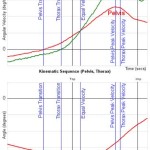
The Kinematic Sequence is an indicator of swing efficiency and speed. If you look at just the downswing phase of the swing (the center section) the graph above displays how fast you turn or swing each part of your body for about 0.25 seconds before impact. During the downswing each part accelerates then decelerates in a smooth and sequential order. In an efficient swing the red (pelvis) curve should peak first followed by the green (thorax) curve then the blue (lead upper arm) curve and finally the brown (shaft)...
Read More »
|
By philcheetham on
6/18/2010 2:27 PM
I am currently working with an LPGA player to improve her efficiency in the kinematic sequence and get her more swing speed. Remember that the kinematic sequence is the graph of turning speed of pelvis (red), thorax (green), arm (blue) and club (brown). It is measured in degrees/second along the vertical axis and shows time through the swing along the horizontal axis. (Check my earlier blog articles for more detail or amm3d.com). After capturing her swing with the AMM3D golf motion capture system, I analyzed it with the TPI 3D biomechanics report. Below is the graph of her kinematic sequence with a driver. There are many “expert” characteristics in the graph; transition order is good, peaking order is good, accelerations and decelerations generally look good too.
...
Read More »
|
By philcheetham on
6/13/2010 5:55 PM
In sports such as golf that need to create maximal speed of a distal segment or implement (club, bat, racket etc.), it is generally found through motion analysis techniques, that there is a precisely timed sequence of body segment motions progressing from the proximal (inner), large segments to the distal (outer), smaller segments. In the biomechanics literature this is often called "proximal-to-distal-sequencing", "kinetic linking" or the term I prefer; the "Kinematic Sequence".
Downswing Phase...
Read More »
|